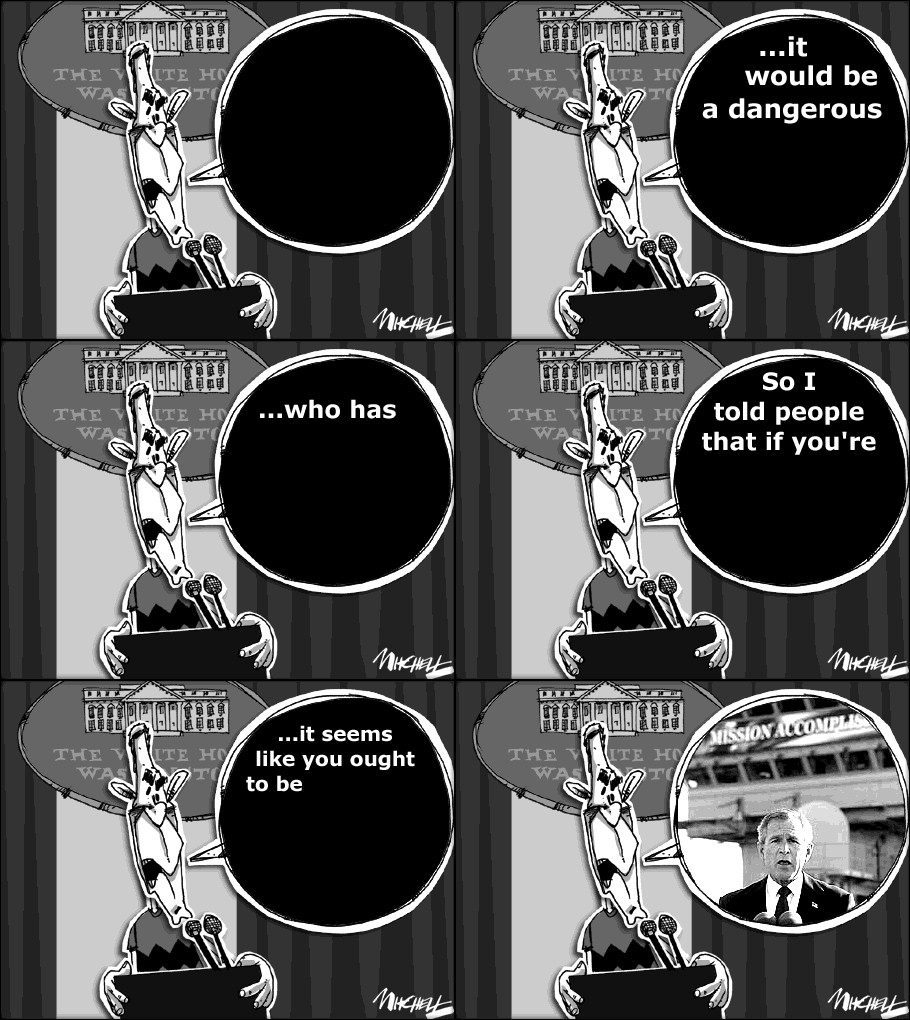
Admittedly, I’m again a little late to the party, but nevertheless I thought I’d recap some key points from the Democratic presidential debate sponsored by MSNBC at Drexel University in Philadelphia on October 30.
Aside from Kucinich equivocating on his UFO experience, the best line of the evening came from Biden: “Rudy Giuliani -- I mean, think about it. Rudy Giuliani -- there's only three things he mentions in a sentence: a noun and a verb and 9/11. I mean, there's nothing else.”
But I digress.
A major portion of the early debate centered around recent legislative developments involving Iran and their potential implications for military intervention there. Edwards pressed Clinton (the only Dem candidate who voted for the Kyl-Lieberman amendment, as Russert points out), saying “she voted to give George Bush the first step in moving militarily on Iran -- and he's taken it.”
Clinton responded by saying that she is against both rushing to war and doing nothing, and instead prefers “vigorous diplomacy,” which includes economic sanctions.
On whether the Kyl-Lieberman measure was a justification for war in Iran, Dodd said that he’s “very concerned that we're going to see those 76 votes come back, being waved in front of us here as a justification when the Bush administration decides to take military action in Iran.”
Biden agreed that it could be used as a declaration of war against Iran, and also noted that it emboldened President Bush and had “incredible consequences for Afghanistan and Pakistan.”
For his part, when asked if he had a “red line” in respect to attacking Iran, Obama said that it was premature to speak of attacking Iran and that “what we should be doing is reaching out aggressively to our allies, but also talking to our enemies and focusing on those areas where we do not accept their actions, whether it be terrorism or developing nuclear weapons…”
When asked the same question, Clinton again emphasized, “we have to try diplomacy, and I see economic sanctions as part of diplomacy. … But I also think when you go to the table to negotiate with an adversarial regime, you need both carrots and sticks.”
Presumably railing against the Kyl-Lieberman amendment, Edwards asked rhetorically, “has anyone read this thing? I mean, it literally gave Bush and Cheney exactly what they wanted.”
Richardson, meanwhile, stated that “we have to use diplomacy. And there is a redline. We cannot permit Iran to use nuclear weapons.” He does, however, note that “we can achieve a compromise on the nuclear issue,” later pleading that “we have to engage them vigorously, potentially also with sanctions.”
Not to be outdone, Kucinich asserted that “we need to adamantly reject any kind of a move toward war with Iran,” arguing that “Even planning for the war against Iran is illegal.”
Then in a strange move Tim Russert asked the candidates if they would “pledge to the American people that Iran will not develop a nuclear bomb while [they] are president” and each predictably responded largely in the affirmative.
After being badgered by Russert, Clinton pledged she “will do everything [she] can to prevent Iran from developing a nuclear bomb;” Edwards proclaimed that he will “take all the responsible steps that can be taken to keep Iran from developing a nuclear weapon;” Biden pledged “to keep us safe” and emphasized the importance of Pakistan; and Dodd agreed.
Notably Richardson also agreed to the pledge, but explained, “what we're also talking about is not just Pakistan. We're talking about enriched uranium, a loose nuclear weapon, nuclear materials, fissionable material throughout the world.”
Kucinich also went further, stating, “It is time that the United States government enforced and participated in fully the Non- Proliferation Treaty, which calls for the abolition of all nuclear weapons. We must lead the way, and we must have a president who understands the danger of these nuclear weapons and have America lead the way among all nations towards nuclear abolition.”
Whew. For those still interested, provided below are the relevant (and admittedly lengthy) portions of the debate as they regard to nuclear weapons and nonproliferation. Key points are bolded. The full transcript can be found here.
Russert: Senator Edwards, you issued a press release, your campaign, and the headline is "Edwards to Clinton: American people deserve the truth, not more doubletalk on Iran."
What doubletalk are you suggesting that Senator Clinton has been engaging in on Iran?
John Edwards: … [Sen. Clinton] says she'll stand up to George Bush on Iran. She just said it again. And, in fact, she voted to give George Bush the first step in moving militarily on Iran -- and he's taken it. Bush and Cheney have taken it. They have now declared the Iranian Revolutionary Guard a terrorist organization and a proliferator of weapons of mass destruction.
[snip]
Russert: … I want to stay on Iran, Senator Clinton.
As you know, you voted for the Kyl-Lieberman amendment, the only member of the stage here who did that.
Senator, Jim Webb of Virginia said it is for all practical purposes mandating the military option, that it is a clearly worded sense of Congress that could be interpreted as a declaration of war.
Why did you vote for that amendment which would -- calls upon the president to structure our military forces in Iraq with regard to the capability of Iran?
Clinton: Well, first of all, I am against a rush to war. I was the first person on this stage and one of the very first in the Congress to go to the floor of the Senate back in February and say George Bush had no authority to take any military action in Iran.
Secondly, I am not in favor of this rush for war, but I'm also not in favor of doing nothing.
Iran is seeking nuclear weapons. And the Iranian Revolutionary Guard is in the forefront of that, as they are in the sponsorship of terrorism.
So some may want a false choice between rushing to war, which is the way the Republicans sound -- it's not even a question of whether, it's a question of when and what weapons to use -- and doing nothing.
I prefer vigorous diplomacy. And I happen to think economic sanctions are part of vigorous diplomacy. We used them with respect to North Korea. We used them with respect to Libya.
And many of us who voted for that resolution said that this is not anything other than an expression of support for using economic sanctions with respect to diplomacy.
You know, several people who were adamantly opposed to the war in Iraq, like Senator Durbin, voted the same way I did, and said at the time that if he thought there was even the pretense that could be used from the language in that nonbinding resolution to give George Bush any support to go to war, he wouldn't have voted for it. Neither would I.
So we can argue about what is a nonbinding sense of the Senate, and I think that we are missing the point, which is we've got to do everything we can to prevent George Bush and the Republicans from doing something on their own to take offensive military action against Iran.
I am prepared to pass legislation with my colleagues who are here in the Congress to try to get some Republicans to join us, to make it abundantly clear that sanctions and diplomacy are the way to go. We reject and do not believe George Bush has any authority to do anything else.
Russert: Senator Dodd, you said that bill was a justification for war in Iran.
Chris Dodd: Well, Tim, I believe that this issue is going to come back to haunt us. We all learned, some of here painfully, back in 2002, that by voting for an authorization regarding Iraq, that despite the language of that resolution which called for diplomacy at the time, this administration used that resolution, obviously, to pursue a very aggressive action in Iraq.
I'm in a view here, what you didn't learn back in '02, you should've learned by now. And you don't just have to listen to this resolution. There's been a series of drumbeats by this administration, by Dick Cheney, by the president, by others, clearly pointing in a direction that would call for military action in Iran.
It is a dangerous view, in my view. And therefore, I thought it was incumbent upon us. It was interesting that people like Dick Lugar, the former Republican chairman of the Foreign Relations Committee, Chuck Hagel of Nebraska -- Republicans who also had serious reservations and voted against that resolution the other day on September 26th.
I'm very concerned that we're going to see those 76 votes come back, being waved in front of us here as a justification when the Bush administration decides to take military action in Iran.
So it was a moment -- it's a critical moment, when I think leadership is called for here. If you're going to seek the leadership of our country, this is the most serious time in a generation. You have an ascending China. You have an Iranian that's ambitious to acquire nuclear weapons. You have, obviously, a $4 trillion economy that's in trouble, a health care crisis in this country, energy and other issues that are going to confront the next president.
Good judgment and leadership at critical moments must be a part of this debate and discussion. That was a critical moment and the wrong decision was made, in my view.
Russert: Senator Biden, do you agree with Senator Webb: It was, de facto, a declaration of war?
Joe Biden: Well, I think it can be used as declaration. Look, we have a problem in the Senate -- and I'm not just directing this at Hillary; there were 75 other people who voted with her; we are in the minority -- that there are consequences for what we do.
And it's not even about going to war. Let's look at what happened from the moment that vote took place. Oil prices went up to $90 a barrel.
Who benefits from that? All this talk of war, all this talk of declaring people to be terrorists droves up the price of oil.
Secondly, we have emboldened Bush, at a minimum, his talk of world war III -- totally irresponsible talk. We've emboldened him, Tim, to be able to move, if he chooses to move.
They're terrorists. The fact that they're terrorists on one side of the border or the other, we just declare them terrorists. That gives him the color of right to move against them.
Thirdly, this has incredible consequences for Afghanistan and Pakistan. Nobody talks about this. The 75 of our colleagues don't understand. We have no driven, underground, every moderate in Pakistan and in Afghanistan.
This literally -- literally puts Karzai, as well as Musharraf in jeopardy. The notion is it plays into this whole urban legend that America's on a crusade against Islam.
This was bad -- if nothing else happens; not another single thing -- this was bad policy. The president had the ability to do everything that that amendment -- that resolution called for without us talking to it.
And all it has done is hurt us. Even if not another single action is taken, actions have consequences. Big nations can't bluff.
Williams: Senator Obama, let's get at this another way. "Red line" is the current expression of the moment where Iran is concerned in Washington. What would your red line be concerning when to, if to attack Iran? What would make it crystal-clear in your mind that the United States should attack Iran?
Obama: I don't think we should be talking about attacking Iran at this point for some of the reasons that Chris and Joe just talked about. Look, we have been seeing, during the Republican debates, the drum beat of war. The president has been talking about World War III.
That is a continuation of the kinds of foreign policy that rejects diplomacy and sees military action as the only tool available to us to influence the region.
And what we should be doing is reaching out aggressively to our allies, but also talking to our enemies and focusing on those areas where we do not accept their actions, whether it be terrorism or developing nuclear weapons, but also talking to Iran directly about the potential carrots that we can provide in terms of them being involved in the World Trade Organization, or beginning to look at the possibilities of diplomatic relations being normalized.
We have not made those serious attempts. This kind of resolution does not send the right signal to the region. It doesn't send the right signal to our allies or our enemies.
And, as a consequence, I think over the long term, it weakens our capacity to influence Iran.
Now, there may come a point where those measures have been exhausted and Iran is on the verge of obtaining a nuclear weapon, where we have to consider other options. But we shouldn't talk about those options now, when we haven't even tried what would be a much more effective approach.
Williams: Same question to Senator Clinton. What would be your red line?
Clinton: Well, first of all, we have to try diplomacy, and I see economic sanctions as part of diplomacy. We have used it with other very difficult situations -- like Libya, like North Korea. I think that what we're trying to do here is put pressure on the Bush administration. Joe is absolutely right. George Bush can do all of this without anybody. You know, that is the great tragedy and that's why we've got to rein him in, and that's why we need Republican support in the Congress to help us do so.
I invite all of our colleagues to pass something immediately that makes it very clear: He has no authority and we will not permit him to go take offensive action against Iran. But what we're trying to do is push forward on vigorous diplomacy. That has been lacking. I believe we should be engaged in diplomacy right now with the Iranians.
Everything should be on the table, not just their nuclear program. I've been advocating this for several years. I believe it strongly.
But I also think when you go to the table to negotiate with an adversarial regime, you need both carrots and sticks. The Revolutionary Guard is deeply involved in the commercial activities of Iran. Having those economic sanctions hanging over their heads gives our negotiators one of the set of sticks that we need to try to make progress in dealing with a very complicated situation.
Everybody agrees up here that President Bush has made a total mess out of the situation with Iran. What we're trying to do is to sort our way through to try to put diplomacy, with some carrots and some sticks, into the mix and get the president to begin to do that.
Williams: Respectfully, Senator, same question though: Do you have a threshold, a red line beyond which...
Clinton: I want to start diplomacy. I -- you know, I am not going to speculate about when or if they get nuclear weapons.
We're trying to prevent them from getting so. We're not, in my view, rushing to war. We should not be doing that, but we shouldn't be doing nothing, and that means we should not let them acquire nuclear weapons. And the best way to prevent that is a full court press on the diplomatic front.
[snip]
Edwards: … Well, I just listened to what Senator Clinton said and she said she wanted to maximize pressure on the Bush administration. So the way to do that is to vote yes on a resolution that looks like it was written, literally, by the neo-cons.
I mean, has anyone read this thing? I mean, it literally gave Bush and Cheney exactly what they wanted. It didn't just give them what they wanted. They acted on it.
A few weeks later, they declared the Iranian Revolutionary Guard a terrorist organization, and -- this is going to sound very familiar -- remember from Iraq? The prelude to Iraq? -- proliferators of weapons of mass destruction.
The way you put pressure on this administration is you stand up to them; you say no.
A lot of us on this stage have learned our lessons the hard way, that you give this president an inch and he will take a mile. And this is about such an important issue, and we have to stand up to this president. We need to make it absolutely clear that we have no intention of letting Bush, Cheney or this administration invade Iran because they have been rattling the saber over and over and over.
And what this resolution did, written literally in the language of the neo-cons, is it enables this president to do exactly what he wants to do. He continues to march forward. He continues to say this is a terrorist organization. He continues to say these are proliferators of weapons of mass destruction.
How in the world is that -- Democrats -- we're not talking about Republicans now, Chris and Joe -- Democrats standing up to this president and saying, "No, we are not going to allow this, we are not going to allow this march to war in Iran"?
Russert: Governor Richardson, would you negotiate with Iran without any conditions?
Bill Richardson: Yes, I would. And I'm the only one on this stage that has actually negotiated with a foreign country...
(Unknown): That's not true.
Richardson: And I want to just say to you that, in my judgment, we have to use diplomacy. And there is a redline. We cannot permit Iran to use nuclear weapons. And I do believe what you do is Ahmadinejad -- it's very difficult to deal with him. But there are moderate elements in Iraq. There are moderate clerics. There's students. There's a business community.
And I believe that we can achieve a compromise on the nuclear issue. In exchange for them having a nuclear fuel cycle, nuclear power, they don't develop nuclear weapons -- carrot and sticks, diplomatic initiatives, economic incentives.
The problem is we saber-rattle. And this resolution in the Senate saber-rattles. I was U.N. ambassador. I know this region. And I do believe that it's critically important that we talk to North Korea, that we talk to Syria, that we talk to Iran.
It's going to take skilled diplomacy. What we have in this administration is a policy of preemption, of saber-rattling, of leaking out potential targets in Iran. That's not going to get diplomacy started.
I believe its critical that if we're going to resolve the situation in the Middle East, if we're going to get Iraq to stop Iran's helping terrorists, we have to engage them vigorously, potentially also with sanctions. We need to get European allies who refuse generally to help us with sanctions, as well as Russia. What you saw recently is Russia and Iran embracing each other. That is not healthy.
Russert: Congressman Kucinich, your opinion of this resolution?
Dennis Kucinich: Well, first of all, we need to adamantly reject any kind of a move toward war with Iran.
There's no basis for it whatsoever. But we have to realize, Tim, that we have a number of enablers who happen to be Democrats who have said over the last year, with respect to Iran, all options are on the table. And when you say all options are on the table, you are licensing President Bush.
And I'm the only one up here on the stage who not only voted against the war in Iraq, voted against funding the war, but also led the effort against Bush's drive toward war.
The problem is: These policies of preemption license a war. Preemption, by virtue of international law, is illegal. Our president has already violated international law.
The war in Iraq is illegal. Even planning for the war against Iran is illegal.
[snip]
Russert: … Senator Clinton, would you pledge to the American people that Iran will not develop a nuclear bomb while you are president?
Clinton: I intend to do everything I can to prevent Iran from developing a nuclear bomb.
Russert: But you won't pledge?
Clinton: I am pledging I will do everything I can to prevent Iran from developing a nuclear bomb.
Russert: But, they may.
Clinton: Well, you know, Tim, you asked me if I would pledge, and I have pledged that I will do everything I can to prevent Iran from developing a nuclear bomb.
Russert: Senator Edwards?
Edwards: What I will do is take all the responsible steps that can be taken to keep Iran from developing a nuclear weapon.
Obama: I think all of us are committed to Iran not having nuclear weapons, and so we could potentially short circuit this.
[snip]
Russert: Senator Biden, would you pledge to the American people that Iran would not build a nuclear bomb on your watch?
Biden: I would pledge to keep us safe. If you told me, Tim -- and this is not -- this is complicated stuff; we talk about this in isolation. The fact of the matter is, the Iranians may get 2.6 kilograms of highly-enriched uranium.
But the Pakistanis have hundreds -- thousands of kilograms of highly-enriched uranium. If by attacking Iran to stop them from getting 2.6 kilograms of highly-enriched uranium, the government in Pakistan falls, who has missiles already deployed with nuclear weapons on them that can already reach Israel, already reach India, then that's a bad bargain.
Presidents make wise decisions informed not by a vacuum in which they operate, by the situation they find themselves in the world.
I will do all in my power to stop Iran from getting a nuclear weapon, but I will never take my eye off the ball. What is the greatest threat to the United States of America: 2.6 kilograms of highly enriched uranium in Tehran or an out-of-control Pakistan? It's not close.
Williams: Senator Dodd?
Dodd: … I agree with Joe. I think the more immediate problem is Pakistan, the one that needs to be addressed. But certainly, bringing that experience together so that you're able to marshal the resources, put together the kind of team, and demonstrate as a result of what you've been able to accomplish over the years that you can actually handle this situation.
Results matter. Experience matters. Having the demonstrated ability to deal with these issues is critical.
So, certainly, I would make a pledge obviously to do everything we can to avoid this problem. But I would suggest to you, Tim, that the more immediate issue is the one exactly that Joe has identified here. Pakistan does pose a more serious issue for this country, and one that needs to be addressed.
[snip]
Williams: Governor Richardson?
Richardson: Well, I would make the pledge. It would be through diplomacy. And what we're also talking about is not just Pakistan. We're talking about enriched uranium, a loose nuclear weapon, nuclear materials, fissionable material throughout the world.
Even more of a threat than nuclear weapons is a loose nuclear weapons crossing the border. So what we need is an international agreement. But the key has to be diplomacy.
[snip]
Williams: Congressman Kucinich, same question.
Kucinich: With all due respect to our friends from the media here, the media itself has to be careful how you frame these questions. We don't want to be put in a position where we are taking this country to the threshold of war. The media did play a role in taking us into war in Iraq. And I'm urging members of the media -- urge restraint upon you and our president, whose rhetoric is out of control.
I would go to Iran and I would urge Iran not just to not have nuclear weapons. I would urge then to give up nuclear power because nuclear power is the most expensive type of power there is. It is not a sustainable type of power because of the costs of it. It is unsafe. I would urge Iran to give up nuclear power.
But I would also do something further. It is time that the United States government enforced and participated in fully the Non- Proliferation Treaty, which calls for the abolition of all nuclear weapons.
We must lead the way, and we must have a president who understands the danger of these nuclear weapons and have America lead the way among all nations towards nuclear abolition.
When we do that, we will have the credibility to go to an Iran and any other nation that may have desires for nuclear power to say, "Look, we want to take it in another direction."
We are not going to stand by and watch our country lost because we are ratcheting up the rhetoric toward war against Iran.
We have to stop this, Tim. We have to stop ratcheting up the rhetoric for war. We really need to stop it.
[snip]
Williams: Senator Obama, was Senator Clinton's answer to the opposition of the Iraq war question consistent, in your view?
Obama: I don't think it's consistent with the Iran resolution, for example, which specifically stated that we should structure our forces in Iraq with an eye toward blunting Iranian influence. It is yet another rationale for what we're doing in Iraq, and I think that's a mistake.
[snip]
Edwards: … And the second thing that I want to make certain that voters are aware of, when we talk -- we've had a long discussion about Iran. And Barack just made the connection to Iran, and there is a very clear connection.
Because we need to learn from the past. And what we've learned from the past is you cannot trust this president. And what I worry about is, if Bush invades Iran six months from now, I mean, are we going to hear: "If only I had known then what I know now?"
Well, we know enough now to know we have to stand up to this president.